
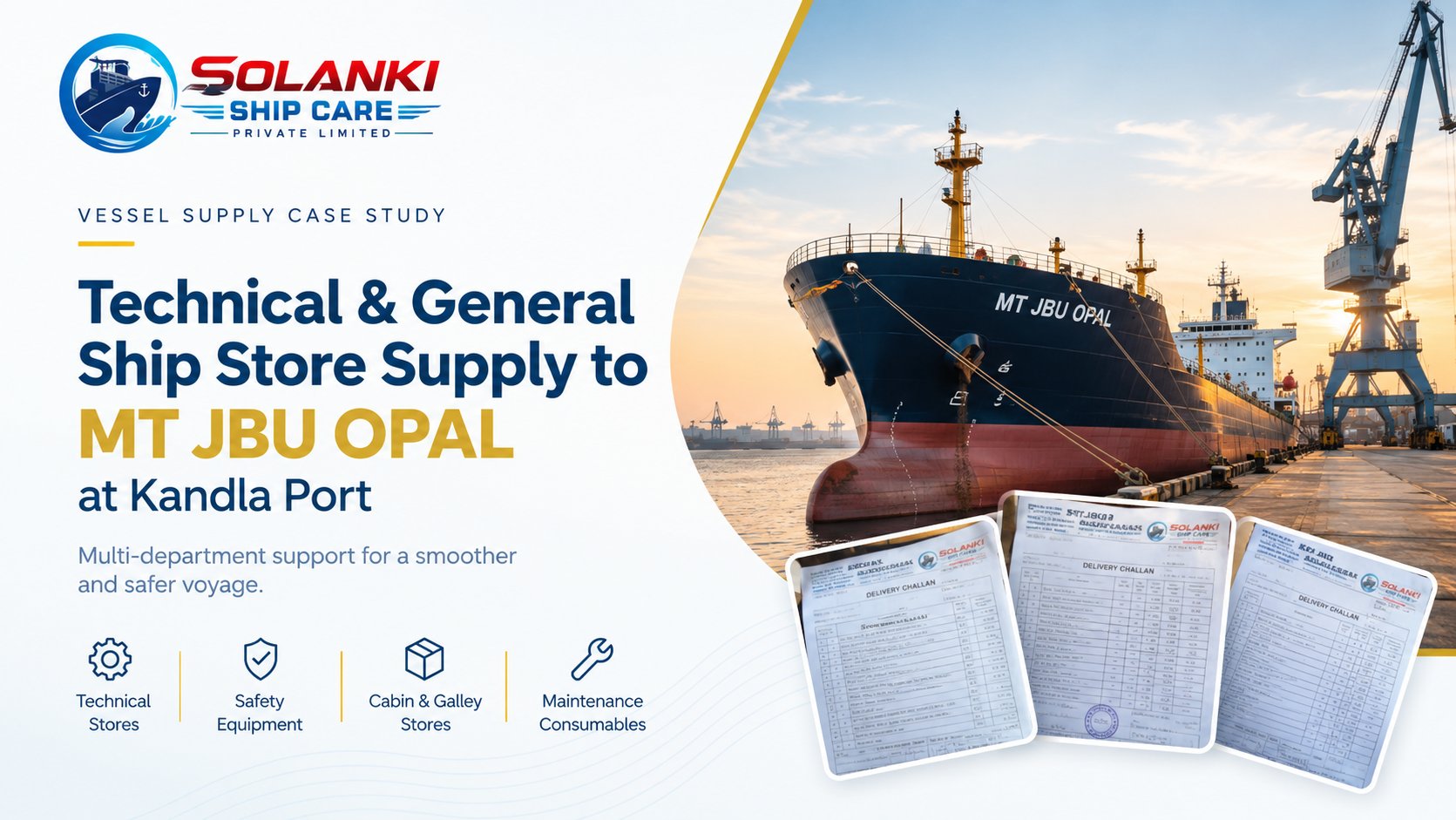
Ship Store Supply to MT JBU OPAL at Kandla Port | Solanki Ship Care
A vessel’s requirement during a port call rarely belongs to only one department. The deck team may require maintenance tools, the engineering department may be looking for fittings or sealing materials, the crew may need additional protective equipment, while accommodation or galley equipment may also need replacement before the vessel sails.
That was the case when Solanki Ship Care completed a comprehensive ship-store supply for MT JBU OPAL at Kandla Port. The requirement brought together technical, operational and everyday vessel stores within one coordinated delivery.
Rather than treating the order as a long list of unrelated products, the supply is better understood as a practical example of how ship chandling supports several onboard departments at the same time.
One Delivery Supporting Multiple Onboard Functions
Supporting Everyday Technical Work Onboard
A large portion of the MT JBU OPAL requirement was built around practical maintenance work carried out by the deck and engineering departments. The vessel required a broad range of tools and workshop items, including different types of wrenches, pliers, screwdrivers, hammers, measuring tools, pneumatic equipment and maintenance accessories.
None of these products is remarkable in isolation. Their importance comes from the working environment in which they are used. A vessel cannot simply postpone every repair until the next shore visit. Crew members routinely perform inspections, adjustments, cleaning, lubrication, fabrication support and smaller repairs while the ship remains in operation.
The requirement therefore extended naturally from tools into engineering consumables and fittings such as steel U-bolts, steel angles, pipe flanges, bearings, gaskets, ball valves and hose-related components. These are the kinds of items that help keep planned maintenance moving when equipment needs servicing.
Tank Measurement and Specialised Maintenance Materials
One of the more technically interesting parts of the supply was an oil gauging tape. Manual tank-measurement tools remain useful aboard vessels where crews need a straightforward way to check liquid levels or carry out tank sounding activities.
The same requirement also included water-finding paste and gasoline or oil-finding paste. Together, these items show how a vessel may require several related products for one operational task rather than one isolated tool.
Oil Gauging Tape
Oil gauging tapes are manual measuring tools used for tank sounding and liquid-level checking. Their value lies in simplicity: they provide crews with a direct physical measurement method that can support routine tank-monitoring activities alongside other onboard systems.
The supply also featured specialist repair and sealing materials, including Devcon Titanium Putty, PTFE tape, silicone gaskets, sealing compounds and Teflon sheets. These products serve different maintenance applications and demonstrate why technical ship supply often depends on getting the requested specification right rather than simply sourcing a generic substitute.
Maintenance Is More Than Major Machinery
The order also contained products that can easily be overlooked because they appear ordinary: paint rollers, wire brushes, radiator brushes, deck scrapers, brooms, lubricants and general cleaning materials.
Onboard, these products support the constant cycle of cleaning, surface preparation, corrosion control and routine upkeep. Steel structures and equipment are continuously exposed to moisture, salt, vibration, cargo residues and mechanical wear, so regular maintenance is part of normal vessel operation rather than an occasional activity.
Providing the correct maintenance consumables allows the crew to continue planned work without depending on shore-side sourcing for every small requirement.
Crew Protection Alongside Technical Supply
The MT JBU OPAL requirement also addressed several forms of personal protection. Working gloves, oil- and acid-resistant gloves, rainwear, disposable boiler suits, ear protection, protective eyewear, safety helmets and steel-toe rubber boots all formed part of the wider supply.
This variety reflects the fact that different onboard jobs create different working conditions. Mechanical maintenance, chemical handling, deck work, painting and noisy machinery spaces do not require the same form of protection. Coordinating PPE together with the tools and materials used for the work gives the vessel a more complete operational supply rather than separating safety from the maintenance activity it supports.
Prepared for Oil Contamination and Routine Spill Response
Oil absorbent material was another practical element of the requirement. Absorbent sheets are useful onboard when oil needs to be collected during maintenance work, minor leakage situations or clean-up activities.
Some of the most useful vessel stores are not large pieces of equipment. They are the consumables crews need immediately when an operational situation develops.
The same principle applies to replacement valve hand wheels, shackles, seals, hose components and other small technical stores. Their purpose is not to attract attention; it is to be available when the crew needs them.
The Vessel Is Also the Crew’s Living Environment
MT JBU OPAL’s requirement extended beyond machinery and maintenance. Cabin, galley and housekeeping items formed part of the same supply operation, including everyday products for accommodation, cleaning and food-preparation areas.
A commercial vessel is both a workplace and a living environment. Accommodation spaces need regular replenishment, galley equipment is used every day, and housekeeping materials are continuously consumed during a voyage.
The requirement also moved beyond small consumables into larger accommodation and galley equipment. An air-conditioning unit for the galley, an R-32 refrigerant cylinder and electric refrigerators formed part of the later supply requirement, demonstrating how ship chandling can shift from minor consumables to technically specified equipment within the same vessel call.
Safety and Lifesaving-Related Requirements
The supply also included safety and lifesaving-related requirements such as IMO safety symbols, emergency-power identification signs, firefighting-related symbols, lifeboat equipment and a lifeboat repair kit.
These products serve a very different purpose from workshop tools or accommodation stores, but they illustrate the diversity that vessel purchasing teams regularly manage. One enquiry may contain valves, maintenance materials and PPE alongside safety identification, lifesaving accessories and office consumables.
Why Consolidated Vessel Supply Matters
What makes this supply significant is not one unusual item. It is the number of onboard requirements handled within one coordinated operation.
Engineering materials appeared alongside PPE. Tank-measurement equipment sat within the same requirement as repair compounds. Spill-response consumables were required together with general tools, while accommodation equipment and refrigeration requirements formed part of the same wider procurement process.
Working with one marine supplier across several categories can simplify communication, reduce the number of separate vendor interactions and give purchasing teams a clearer channel for delivery planning and onboard handover.
From the vessel’s perspective, the most important question is not which supplier category an item belongs to. It is whether the correct requirement can be coordinated for the right vessel, at the right port, within the available operational window.
MT JBU OPAL — Kandla Port
The multi-category supply was coordinated and delivered to support the vessel’s technical, safety, maintenance, accommodation and operational requirements.
Ship Chandler at Kandla Port
Solanki Ship Care supports vessels requiring ship stores and marine supplies at Kandla Port, including deck and engine consumables, technical stores, PPE, cabin requirements, maintenance materials, safety-related stores and other vessel requirements.
Whether an RFQ contains a small group of specialised technical products or a multi-page requirement covering several departments, effective ship chandling depends on understanding the specification, coordinating procurement and planning delivery around the vessel’s port call.
Common Questions
Frequently Asked Questions
Learn more about the ship store supply completed by Solanki Ship Care for MT JBU OPAL at Kandla Port.
What types of ship stores were supplied to MT JBU OPAL?
The supply for MT JBU OPAL at Kandla Port covered ten categories: workshop and hand tools, pipe fittings and engineering components, tank measurement equipment, maintenance compounds and sealing materials, deck maintenance consumables, PPE and protective equipment, oil absorbents and spill-control materials, cabin and galley stores, refrigeration and galley equipment, and safety, lifesaving and IMO symbol items.
What is an oil gauging tape and why is it used on vessels?
An oil gauging tape is a precision instrument used to measure the depth of liquid in ship tanks by lowering the tape into the tank opening. It is used to determine fuel, ballast and cargo tank levels for operational and stability purposes. The tape is constructed from materials resistant to petroleum products and is marked at precise intervals to allow accurate sounding readings.
Does Solanki Ship Care supply refrigeration equipment to vessels?
Yes. In addition to consumable stores, Solanki Ship Care can coordinate the supply of refrigeration and galley equipment. For MT JBU OPAL, the supply included an AC unit for the galley, R-32 refrigerant cylinders for system servicing and electric refrigerators for cabin or provision storage use. These are coordinated through the same vessel supply arrangement as consumable stores.
Why are IMO safety symbols included in ship store orders?
IMO safety symbols are mandatory on SOLAS-regulated vessels. They mark the location of firefighting equipment, lifesaving appliances, emergency procedures and evacuation routes in a standardised format that all crew members can understand regardless of language. Signage becomes faded or damaged with use and exposure to the marine environment, so replacement forms part of planned maintenance work. They are treated as a ship store item and are ordered through the chandler during port calls when replenishment is required.
Can Solanki Ship Care handle multi-department vessel supply at Kandla Port?
Yes. The supply to MT JBU OPAL is an example of how Solanki Ship Care coordinates requirements from different onboard departments — deck, engine room, safety, galley and accommodation — within a single port call and delivery arrangement. This consolidated approach reduces the number of purchase orders, suppliers and delivery windows the vessel's operations team needs to manage during the call. Kandla Port is one of several major Indian ports where this service is available.